Reference Centre
Return to the Network Analyser Application Notes
Overview
Cellular networks do not broadcast operator names such as Vodafone, O2 or EE directly over the air. Instead, they broadcast numerical identifiers known as the Mobile Country Code (MCC) and Mobile Network Code (MNC). SNYPER uses these values to identify networks, display operator names and detect situations where multiple operators share the same radio infrastructure. Understanding these identifiers is essential when interpreting survey results and selecting suitable operators for deployment.
¶ Introduction
Every cellular network broadcasts identification information that allows mobile devices to determine:
- Which country the network belongs to
- Which operator owns or operates the network
- Whether roaming is permitted
- Which services are available
SNYPER extracts this information during every survey and displays:
- MCC
- MNC
- PLMN
- Network Name
- Cell ID
- TAC/LAC
- Frequency information
These identifiers form the basis of network identification throughout the SNYPER product family.
¶ Objectives
This guide explains:
- Mobile Country Codes (MCC)
- Mobile Network Codes (MNC)
- Public Land Mobile Networks (PLMN)
- How SNYPER identifies operators
- Why networks sometimes appear multiple times
- Cell sharing between operators
- Multi-PLMN broadcasting
- How to correctly interpret survey results
- Best practices for dual-SIM deployments
Expected Result
At the end of this guide the user will understand how network identifiers are used by SNYPER and how to recognise shared cellular infrastructure during a survey.
¶ Mobile Country Code (MCC)
¶ What is MCC?
The Mobile Country Code identifies the country associated with a cellular network.
The MCC always consists of:
Three digits
Example:
| MCC | Country |
|---|---|
| 234 | United Kingdom |
| 208 | France |
| 310 | United States |
| 262 | Germany |
SNYPER records the MCC of every detected network during a survey.
¶ MCC Geographic Regions
The first digit indicates the geographic region.
| First Digit | Region |
|---|---|
| 0 | Test Networks |
| 2 | Europe |
| 3 | North America & Caribbean |
| 4 | Asia & Middle East |
| 5 | Australia & Pacific |
| 6 | Africa |
| 7 | South & Central America |
| 9 | Worldwide Networks |
Examples of worldwide networks include:
- Maritime systems
- Aircraft systems
- Private satellite networks
- Antarctic deployments
¶ Mobile Network Code (MNC)
¶ What is MNC?
The Mobile Network Code identifies the operator within a country.
The MNC consists of:
Two or three digits
Examples:
| MCC | MNC | Operator |
|---|---|---|
| 234 | 15 | Vodafone UK |
| 234 | 10 | O2 UK |
| 234 | 30 | EE UK |
| 234 | 20 | Three UK |
SNYPER uses the MCC and MNC together to determine the operator name displayed in survey results.
¶ PLMN (Public Land Mobile Network)
¶ What is a PLMN?
The PLMN uniquely identifies a cellular network worldwide.
It is created by combining:
MCC + MNC = PLMN
Example:
| MCC | MNC | PLMN |
|---|---|---|
| 234 | 15 | 23415 |
| 234 | 10 | 23410 |
| 234 | 30 | 23430 |
The PLMN uniquely identifies the network regardless of country or operator.
¶ How SNYPER Identifies Networks
During a survey SNYPER examines the network broadcast information transmitted by each detected cell.
The network broadcasts:
- MCC
- MNC
- Cell ID
- Tracking Area Code (TAC)
- Frequency information
- Operational parameters
SNYPER extracts these values and performs a lookup using the internal PLMN database to determine the operator name displayed in reports.
¶ Understanding Survey Results
Typical survey reports contain:
| Field | Description |
|---|---|
| MCC | Mobile Country Code |
| MNC | Mobile Network Code |
| CellID | Unique Cell Identifier |
| TAC | Tracking Area Code |
| EARFCN | LTE frequency channel |
| Band | Operating frequency band |
| Signal Level | Received signal strength |
| Network Name | Operator name derived from PLMN |
¶ One Network Broadcasting Multiple PLMNs
In some situations the same physical network may broadcast multiple PLMNs.
This can occur due to:
- Historical operator mergers
- MVNO arrangements
- Legacy roaming agreements
- Regulatory requirements
The survey example below shows the same physical cell broadcasting multiple PLMNs.
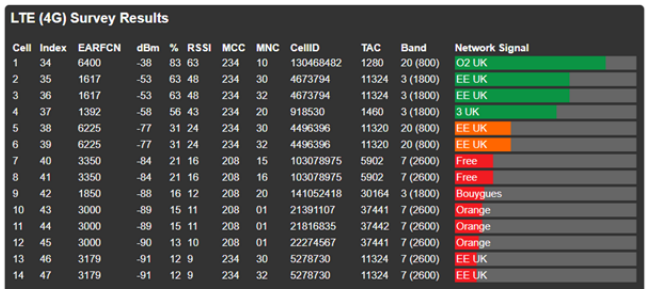
Cells with identical:
- CellID
- TAC
- Frequency
- Signal level
but different MNC values are often the same physical radio cell broadcasting multiple PLMNs.
¶ Why This Matters
Without understanding PLMN sharing, a survey may appear to show:
More networks than actually exist
In reality:
One physical cell
Multiple PLMN identities
This distinction is important when assessing:
- Network diversity
- Resilience
- Backup connectivity options
¶ Interpreting Summary Results
SNYPER summary reports group results by:
PLMN
rather than simply by network name.
This avoids counting shared PLMNs as independent infrastructure.
Example summary:
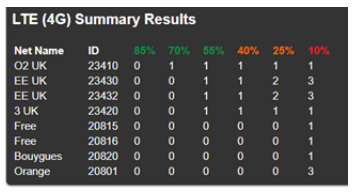
This allows the installer to understand the true distribution of available networks.
¶ Cell Sharing Between Operators
¶ What is Cell Sharing?
Modern LTE and 5G networks may allow multiple operators to use the same physical radio infrastructure.
A single base station may broadcast:
Operator A
Operator B
Operator C
using the same radio equipment and antenna system.
¶ Identifying Shared Cells
A shared cell can often be recognised when:
- Cell ID is identical
- TAC is identical
- Frequency is identical
- Signal level is identical
but
- MNC differs
Example:
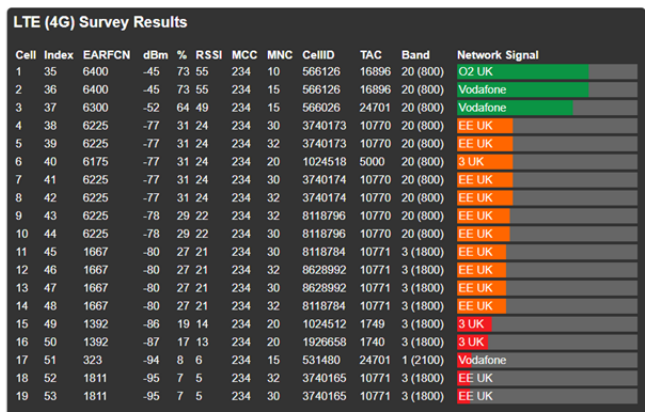
The same physical radio infrastructure is serving multiple operators.
¶ Practical Deployment Impact
This can have significant implications for resilience.
For example:
| SIM 1 | SIM 2 |
|---|---|
| O2 | Vodafone |
may appear to provide redundancy.
However, if both operators share:
- the same tower
- the same radio equipment
- the same backhaul
then both services may fail simultaneously if that infrastructure becomes unavailable.
¶ Dual-SIM Router Selection Example
¶ Poor Selection
| SIM 1 | SIM 2 |
|---|---|
| O2 | Vodafone |
if both operators originate from the same physical cell.
Failure of the shared infrastructure affects both connections.
¶ Better Selection
| SIM 1 | SIM 2 |
|---|---|
| Vodafone | EE |
when supplied from independent infrastructure.
This improves redundancy and network diversity.
¶ Antenna Considerations
Survey results can also reveal which frequency bands dominate at a location.
For example:
| Band | Frequency |
|---|---|
| Band 20 | 800 MHz |
| Band 3 | 1800 MHz |
| Band 1 | 2100 MHz |
If Band 20 dominates the available coverage, an antenna optimised for:
800 MHz LTE
may provide the best overall performance.
¶ Common Interpretation Mistakes
| Mistake | Consequence |
|---|---|
| Counting PLMNs as independent cells | Overestimating network diversity |
| Ignoring Cell IDs | Missing shared infrastructure |
| Selecting operators solely by name | Reduced resilience |
| Ignoring frequency bands | Poor antenna selection |
| Assuming dual-SIM equals redundancy | Shared infrastructure failures |
¶ Best Practice Recommendations
When evaluating survey results:
- Compare Cell IDs
- Compare TAC values
- Compare frequencies
- Review PLMN identifiers
- Identify shared infrastructure
- Select genuinely independent operators
- Match antenna selection to dominant bands
- Use summary reports to verify network diversity
¶ Related Documents
- Common Cellular Terminology
- LTE Terminology
- 5G NR Terminology
- Signal Quality Interpretation Guide
- Practical Survey Interpretation Guide
¶ Process Summary
| Step | Action |
|---|---|
| 1 | Identify MCC and MNC |
| 2 | Determine PLMN |
| 3 | Compare Cell IDs |
| 4 | Compare TAC values |
| 5 | Identify shared infrastructure |
| 6 | Review summary results |
| 7 | Select suitable operators |
| 8 | Validate deployment resilience |
Reference Centre
Return to the Network Analyser Application Notes
Support
For further assistance, please contact the Siretta support team.